Practical advice
How to keep bird seed dry in wet weather
Practical ways to protect a feeder from rain, reduce condensation and deal safely with damp seed.
Put out only enough food to be eaten within one or two days.
Check the lid, ports, base and drainage after prolonged rain.
Never top fresh seed onto a damp layer or return leftovers to storage.
Rain does not always enter from above. Wind can drive water through feeding ports, condensation can form inside a tube, and runoff can travel down a hanger. The best solution is usually a combination of sensible positioning, clear drainage and smaller quantities of food.
Current RSPB feeding guidance says food should be kept as dry as possible and seed should be eaten within one or two days. That short turnover is your best protection when the forecast is poor.
Work out where the moisture is coming from
Inspect the feeder during or just after rain, provided it is safe to do so. Look for:
- Water entering around a loose or warped lid
- Wind-driven rain reaching the feeding ports
- Condensation on the inside of a clear tube
- Runoff following a hanging wire, hook or pole
- Blocked drainage at the base
- A crack or damaged joint
Finding the route matters. A larger roof will not solve condensation, and moving the feeder will not help if a cracked base is holding water.
Start with smaller fills
Do not fill a large reservoir simply because it has the capacity. Put out only what birds are likely to eat within a day or two, and use even less during wet or quiet spells. The guide to how much bird food to put out gives a simple way to adjust the next fill from what remains.
Empty the feeder before adding fresh food. Topping up can bury an older damp layer at the bottom, where it is difficult to see. If turnover is consistently slow, reduce the quantity again rather than waiting longer between checks.
Check the feeder design
A useful wet-weather feeder has a lid that seats properly, drainage at the lowest point and a base you can remove for cleaning. A clear or partly visible reservoir also makes clumping and condensation easier to spot.
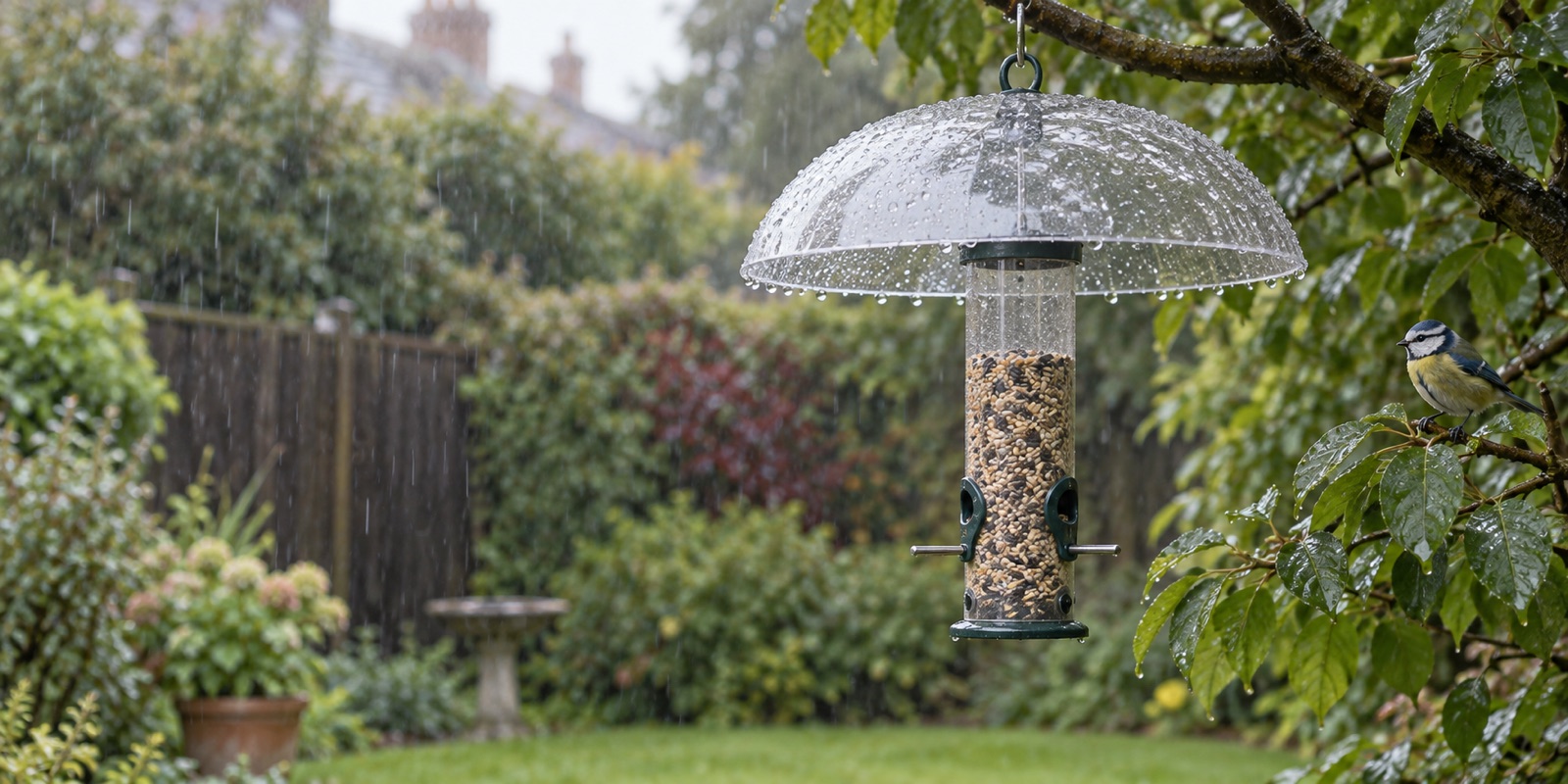
Ventilation can reduce condensation, but openings may admit driven rain. A seed shield or rain guard can reduce direct exposure, but it cannot guarantee that the contents stay dry. Use accessories designed for the feeder and make sure they do not obstruct birds, overload the support or make cleaning difficult.
Choose a better position
Shelter from the prevailing wind and rain can help, but avoid positions beneath gutters, roof drips or branches where birds regularly roost. Dense, enclosed cover may stay humid even when it blocks direct rain.
The position should also remain easy for you to reach. A feeder that stays untouched because it is awkward to take down will not be a good wet-weather solution.
Observe the whole station after moving it. Water can travel along a bracket or hanging chain in ways that are not obvious on a dry day.
Keep drainage clear
Drainage holes only work when they are open. Fine seed fragments and swollen husks can form a plug in the base, so inspect the lowest point whenever you refill.
Do not push dirt further into the feeder with a sharp tool. Empty and dismantle it, then clean the openings with a suitable brush. If drainage is too enclosed to reach, consider replacing the feeder with a more manageable design.
How to tell when bird seed has spoiled
Discard the whole fill if any of it is:
- Damp or clumped together
- Musty or sour-smelling
- Mouldy or discoloured
- Contaminated with droppings or pests
- Sitting in water or against a wet base
Do not pick out the wet section, spread the seed elsewhere or attempt to dry it for reuse. Seal it in household waste so wildlife cannot retrieve it. Follow the complete wet or mouldy bird-seed clean-up before refilling.
What to do after heavy rain
- Stop refilling and inspect the food, ports and base.
- Discard the fill if there is any moisture, clumping or unusual smell.
- Dismantle the feeder outdoors while wearing gloves.
- Wash, disinfect and rinse every part.
- Let it dry completely before reassembly.
- Clear old food and droppings from beneath the station.
- Refill with a smaller amount only if current seasonal guidance permits.
Our complete feeder-cleaning guide covers the safe method in more detail.
Store unopened seed properly too
Keep reserve food in a clean, sealed container in a cool, dry place with little temperature variation. Use a dry scoop and close the container immediately after use. Never return food from an outdoor feeder to the main supply.
Buy an amount you can use while it remains fresh. Continually topping up the storage bin can leave older food hidden at the bottom, so empty and clean the container before replenishing it.
Frequently asked questions
Can I add rice or another absorbent to the feeder?
No. Do not mix unapproved material into bird food. Correct the exposure, drainage, storage or fill size instead.
Is a rain dome enough on its own?
No. A dome can reduce direct rain, but it cannot prevent condensation, driven rain or blocked drainage.
Can I wipe damp seed and refill the feeder?
No. Discard the food, then clean and dry the feeder fully before using it again.
What if the same feeder keeps getting wet?
Check for damage, change the position and reduce the fill. If the design still cannot keep a short supply in good condition, replace it with one that has a better lid, accessible drainage and a removable base. Our best bird feeder guide includes cleanability and weather management in the comparison.
Helpful products
Feeders that make moisture easier to manage
No feeder is completely weatherproof. These options make it easier to see the food, dismantle the feeder and—on the larger model—allow air to move around the seed tube.
RSPB Classic easy-clean seed feeder (small)
Best for: Small fills that are easy to inspect and remove
A simple 500ml, two-port feeder with a polycarbonate tube and plastic fittings that come apart without tools.
What stands out
- Clear 500ml tube
- Base and fittings come apart without tools
- Two-port design suits modest fills
Keep in mind
- Plastic parts are not squirrel-proof
- No feeder can keep seed dry in every position
- 500ml capacity
- Two ports
- Removable parts
Brome Squirrel Buster Plus
Best for: Busy stations that also have persistent squirrel pressure
Brome’s largest feeder uses an adjustable weight-operated shroud, chew-resistant fittings and a ventilated 2.8L seed tube that dismantles by hand.
What stands out
- Ventilated seed tube
- Tool-free dismantling
- Adjustable weight-operated shroud
Keep in mind
- Large capacity makes overfilling tempting
- Bulky and expensive for a quiet garden
- Approx. 2.8L
- Ventilated tube
- Adjustable shroud