
Feeder features
Which bird feeders are easiest to clean?
Four bird feeders that come apart easily, plus the design details that make weekly cleaning less of a chore.
Our recommendations
Easy-clean feeders to compare
Four feeders that can be taken apart without tools, with different trade-offs in size, access and squirrel resistance.
RSPB Classic easy-clean seed feeder (small)
Best for: A simple, easy-clean feeder for most gardens
A simple 500ml, two-port feeder with a polycarbonate tube and plastic fittings that come apart without tools.
What stands out
- Comes apart without tools
- Compact two-port design
- Clear tube makes the food level easy to see
Keep in mind
- Plastic fittings can be damaged by squirrels or parakeets
- 500ml capacity
- Two feeding ports
- Polycarbonate tube
Jacobi Jayne Ring-Pull feeder
Best for: Anyone who wants quick access to the tube and ports
Its twist base and removable pin release the component parts, making the main feeding areas easier to reach during cleaning.
What stands out
- Pin-release design
- Separates into washable parts
- Straightforward everyday seed feeder
Keep in mind
- Does not stop squirrels on its own
- Medium seed feeder
- Ring-Pull release
- Hanging design
Brome Squirrel Buster Mini
Best for: Smaller gardens where squirrels regularly reach the feeder
A compact four-port feeder with a weight-operated shroud that closes access when a squirrel lands on it.
What stands out
- Weight-operated shroud
- Four feeding ports
- More compact than the Plus
Keep in mind
- Trigger sensitivity is not adjustable
- Needs clearance from launch points
- Approx. 550ml
- Four ports
- Weight-operated closure
Brome Squirrel Buster Plus
Best for: Busy winter feeding stations with persistent squirrel pressure
Brome’s largest feeder uses an adjustable weight-operated shroud, chew-resistant fittings and a ventilated 2.8L seed tube that dismantles by hand.
What stands out
- Adjustable weight setting
- Chew-resistant fittings
- Large ventilated seed tube
Keep in mind
- Bulky and expensive
- Capacity can encourage overfilling
- Approx. 2.8L
- Adjustable shroud
- Tool-free dismantling
The easiest feeder to clean comes apart without improvisation, exposes the bottom of the food reservoir and lets a brush reach ports, seams and drainage. It should also be simple enough to clean at least weekly, as current RSPB guidance requires.
Current hygiene baseline
The RSPB advises not offering seeds or peanuts between May and November because of disease-transmission risk. At other times, provide only one or two days’ food, keep it dry, clear debris, move positions and use several small feeding points. Flat tables and trays—including window trays—should be avoided because cleaning does not remove their additional risk. Read current RSPB guidance.
Our easiest-to-clean picks
RSPB Classic easy-clean seed feeder
The Classic is 31.3cm with two ports and 500ml capacity. Its UV-stable tube and plastic components dismantle without tools.
Why it stands out: the simple construction makes weekly cleaning straightforward. Drawback: RSPB warns that squirrels or parakeets may damage the plastic, so inspect it for rough or unsafe edges. RSPB product details.
Jacobi Jayne Ring-Pull
Twisting the base and pulling a pin separates the feeder. Jacobi Jayne attributes a lifetime guarantee to the range, subject to its current terms.
Why it stands out: the base and pin release the feeder without tools. Drawback: the pin is easy to misplace, and the narrow port pieces still need brushing. Jacobi Jayne product details.
Brome Squirrel Buster Plus
The large 2.8L weight-operated model dismantles by hand and uses a ventilated seed tube with an adjustable shroud.
Why it stands out: the main components separate without tools despite the feeder’s moving mechanism. Drawback: the long body and shroud track create more surface to clean, and the capacity is excessive for a quiet garden. Brome product details.
Brome Squirrel Buster Mini
This four-port feeder is about 550ml and 454g; its non-adjustable shroud closes under excess weight and it dismantles by hand.
Why it stands out: its compact body comes apart by hand. Drawback: the tracks and small spaces around the mechanism may need a bottle brush. Brome product details.
Seven details to check
Look for tool-free but secure releases; a removable base; direct sight into corners; drainage at the lowest point; smooth compatible materials; replaceable components; and instructions clear enough to reassemble the feeder safely. “Dishwasher safe” or disinfectant compatibility should never be assumed—follow the manufacturer.
Avoid decorative seams, inaccessible false bottoms and guards that cannot be separated. A bottle brush is useful for narrow tubes, but it must be dedicated to feeder care and able to dry between uses.
Cleaning still requires the full method
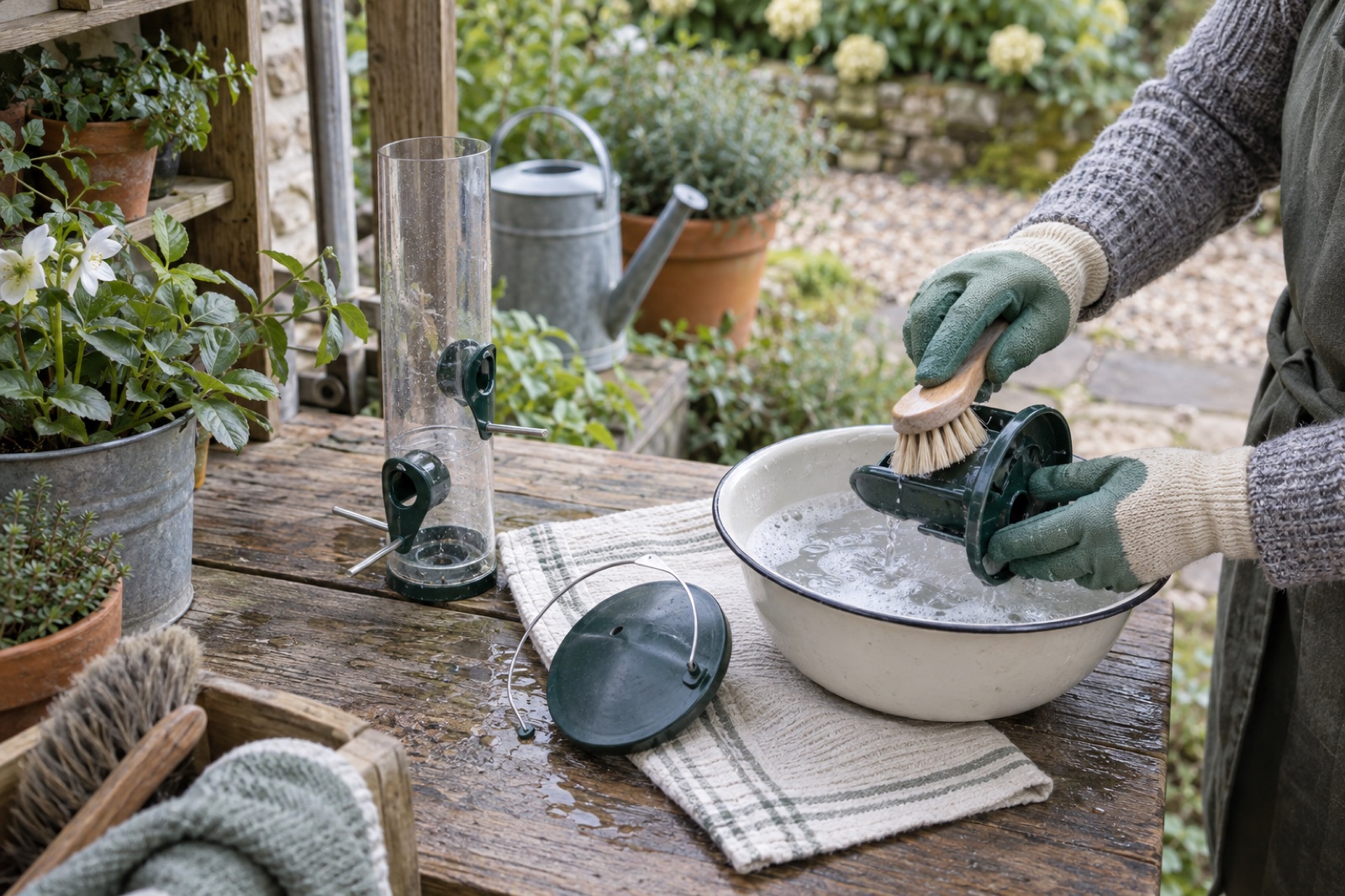
Work outside, wear gloves, discard leftovers, dismantle and wash in hot soapy water. Use an animal-safe disinfectant or mild 5% bleach where appropriate, following instructions and never mixing products. Rinse and dry fully, clean the ground, then wash hands and forearms. Our step-by-step guide owns the procedure; the weekly schedule owns timing.
Easy cleaning is only part of the decision. For food, positioning, squirrel pressure and other trade-offs, use the main feeder guide.
What to check before buying
Look for an exploded view or clear dismantling instructions. Count the joins where the tube, base, ports and perches meet. Confirm whether the inner feeder separates from a guard, whether you can brush drainage holes from both sides and whether replacement parts are available. If a product is described as “easy clean” but never shows how the parts release, be cautious.
Dimensions matter because they determine brush access. The Brome Mini is a compact tube format, while the much larger Plus brings a longer chamber and more mechanism. Buy suitable dedicated brushes at the same time only after confirming they will not scratch or damage the material.
What tool-free should mean
Tool-free is valuable for weekly work, but releases must not open accidentally. Pins should seat positively; twist bases should lock; lids should not rely on worn friction alone. After reassembly, gently check each connection before hanging and filling. Never modify a safety-critical latch simply to make dismantling faster.
When replaceable parts matter
A worn perch, cracked tube or corroded fitting should not remain outside. A manufacturer-supported spare can avoid discarding the entire feeder, but current availability and guarantee terms must be checked. Jacobi Jayne’s lifetime-guarantee wording is attributed to the maker, not treated as an unconditional promise by this site.
FAQs
Is a flat tray easiest of all?
It may be physically easy to wipe, but current RSPB advice is to avoid flat feeding surfaces because of added disease risk. Cleanability is not the only welfare criterion.
Can every feeder use 5% bleach?
No. Use mild 5% bleach only where appropriate under current guidance and compatible instructions. Never mix chemicals, and always rinse and dry fully.
How often should removable parts come off?
At every full clean—at least weekly under current RSPB guidance, and sooner when conditions require.
Is a large capacity helpful?
Only when food safely turns over. The one-to-two-day food limit should determine the fill, regardless of reservoir size.
How a well-designed feeder comes apart
A sensible sequence removes food, lifts the lid, releases the hanger if necessary, separates tube from base and then frees ports or mesh sections. Each action should expose rather than conceal the next dirty surface. Instructions should also show the reverse order and identify a positive lock at the end.
Be cautious where dismantling requires flexing ageing plastic, compressing an unguarded spring or remembering an undocumented alignment. Easy cleaning includes safe, repeatable reassembly.
Hidden hygiene traps
Residue commonly sits under a base lip, behind a port collar, inside a hollow perch, around a screw thread, beneath a seed shield and where a cage touches its support. Sliding shrouds and closing ports introduce tracks that may look clean from outside. Transparent tubes make the main chamber visible but do not reveal every interface.
Before buying, enlarge the product diagrams and look for those junctions. If no photograph or instruction shows the base removed, do not assume it comes off.
Brushes, washing and soaking
A broad brush handles lids and exposed bases; a bottle brush reaches narrow tubes; a smaller brush reaches ports, mesh and threads. All should be reserved for feeder care. Soaking can loosen residue only where the manufacturer and cleaning-product instructions permit it; it does not replace brushing, appropriate disinfection or rinsing.
Never force an oversized brush into a tube or scrape a coating. Damage that creates scratches, cracks or loose finish undermines the purpose of cleaning.
Drying is part of cleanability
Parts should stand separately so water leaves seams and hollow areas. A design that traps water when dismantled may require more drying time than its marketing implies. Before reassembly, shake and inspect each component, then confirm drainage and moving parts remain open.
Replaceable parts and service life
Cleaning reveals wear. Clouding alone may be cosmetic, but cracks, sharp edges, distorted cages, unreliable catches and corroded food-contact parts need action. Check official spares and current guarantee terms. Replaceable parts support longevity only when the exact component is available and can be fitted as instructed.
How much work does each feeder involve?
The Classic keeps the construction simple, although its plastic needs damage checks. Ring-Pull has a clear pin-release system but introduces a small part to retain. The Mini is compact but adds a shroud track and narrow areas. The Plus also comes apart by hand, although its size makes washing and drying more cumbersome. Those practical differences matter more than an “easy clean” badge.
Who should choose a simpler feeder?
Anyone unable to handle multiple clips, retain small parts or reach a long tube should prioritise the fewest accessible components. A mechanism that solves a problem but makes weekly cleaning unrealistic is the wrong compromise. Ask whether another station position can solve squirrels before accepting extra moving parts.
For named models that meet these criteria, compare our best easy-clean bird feeders. The buying guide ranks specific products; this page remains the checklist for judging any design.